The ROI of Nearshore Staffing: A Breakdown for Finance-Minded Founders
For finance-minded founders, the question is:
How much does it cost to add one more unit of reliable engineering output, and how fast does that investment pay back?
This breakdown walks through the real cost stack of a U.S. hire vs. a nearshore hire (LATAM), the hidden expenses founders routinely miss, and a simple ROI framework you can reuse for your own model.
Executive summary
Here are the most common drivers behind nearshore ROI:
U.S. comp is not just salary. Benefits are a meaningful share of total employer cost; in BLS ECEC data (private industry), benefits are ~29.9% of total compensation (Dec 2025 release).
Developer salary benchmarks are high. The BLS Occupational Outlook Handbook reports the median annual wage for software developers at $133,080 (May 2024).
Hiring itself costs money. SHRM benchmarking reports $5,475 average cost-per-hire for nonexecutive roles (2025 report).
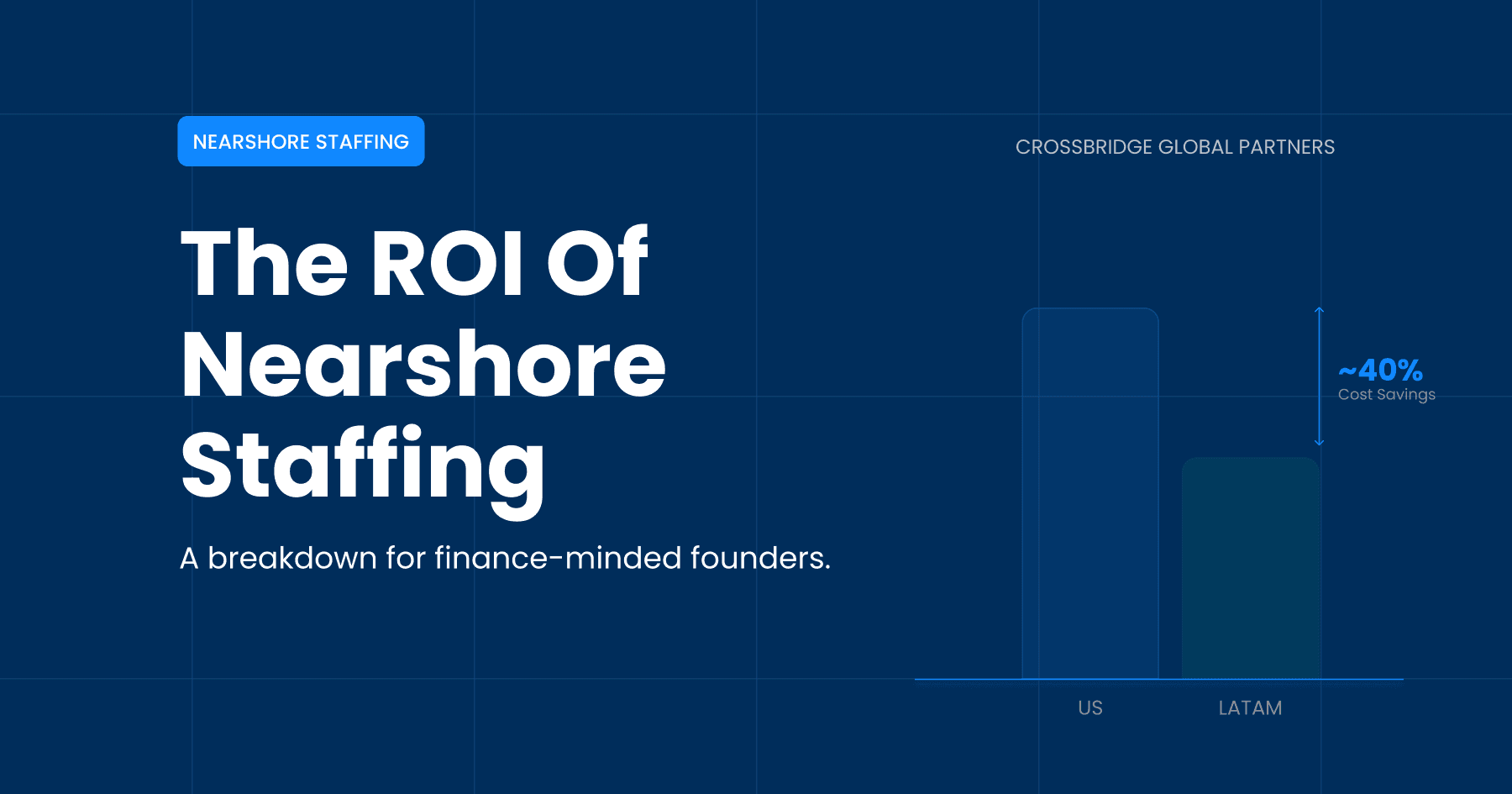
Nearshore can reduce fully loaded cost significantly when you hire full-time talent in LATAM through a compliant model (EOR/COR), while preserving timezone overlap. (Exact savings depends on role, seniority, and model.)
1) The mistake: comparing salary to hourly rate
Founders often compare:
U.S. employee salary (e.g., $150k)
vs.
nearshore hourly contractor rate (e.g., $45/hr)
That’s not an apples-to-apples comparison.
A clean comparison is:
Fully loaded annual cost of a U.S. full-time employee
vs.
Fully loaded annual cost of a nearshore full-time employee (or nearshore engagement cost, if through a partner)
“Fully loaded” means salary + benefits + taxes + recruiting + equipment + management time + risk.
2) The true cost stack of a U.S. engineering hire
A) Base salary
BLS reports the median annual wage for software developers at $133,080 (May 2024).
Source: https://www.bls.gov/ooh/computer-and-information-technology/software-developers.htm
Many venture-backed companies pay above median—especially for senior roles and competitive markets.
B) Benefits
BLS Employer Costs for Employee Compensation (ECEC) shows that for private industry, total benefits are 29.9% of total compensation (Dec 2025).
Source: https://www.bls.gov/news.release/ecec.t04.htm
This includes:
health insurance
paid leave
retirement/savings
legally required benefits
C) Hiring + vacancy costs
Even before a developer writes code, you pay:
recruiter time / fees
interview time from senior staff
tooling and onboarding overhead
SHRM’s 2025 benchmarking highlights a $5,475 average cost-per-hire for nonexecutive roles.
In high-scarcity roles (engineering), the real cost often rises because the interview loop is expensive and time-to-fill is longer.
D) The “ramp” period
A realistic model assumes new hires take time to become net-positive, especially in:
complex codebases
regulated industries
high-coordination product teams
Your ROI model should treat the first 30/60/90 days as partial output, not full output.
3) The nearshore cost stack
Nearshore can mean:
contractors
staff augmentation
dedicated teams
EOR/COR employment (full-time hire, compliant)
For a founder ROI model, include:
A) Base comp
LATAM salary bands vary by country and seniority.
(Some providers publish payroll-backed benchmarks; if you use those, prefer “verified payroll data” over scraped job boards.)
B) Statutory employer costs (country-specific)
Depending on country, employer taxes and statutory benefits can be material. Good models include them explicitly rather than burying them in a blended hourly rate.
C) Partner fees
These typically cover:
compliant employment
payroll and benefits admin
local legal/tax handling
support services (varies by partner)
D) Integration cost (the part that decides ROI)
The ROI comes from:
timezone overlap
communication quality
ownership
retention
Nearshore fails when teams are treated as “outsourced capacity” instead of embedded teammates with shared standards.
4) A simple ROI framework for finance-minded founders
Use this model to evaluate any option (U.S., nearshore, hybrid):
Step 1 — Define the unit of value
Choose one:
features shipped per month
story points (only if your team measures consistently)
cycle time reduction
revenue impact for a roadmap milestone
Step 2 — Estimate fully loaded cost (annual)
Fully loaded cost = salary + benefits/taxes + recruiting + tooling + management overhead + risk buffer
Step 3 — Apply an output multiplier
Ramp factor (first 90 days)
Collaboration factor (timezone + communication)
Quality factor (rework/defects)
Step 4 — Compare “cost per unit of output”
That number is your real ROI basis.
5) The hidden ROI lever: time-to-hire + time-to-value
Nearshore often wins when:
U.S. hiring is slow
roadmap pressure is high
missed deadlines have real opportunity cost
If nearshore helps you ship a revenue-driving feature one quarter earlier, the ROI can dwarf payroll savings.
6) The conclusion (what to say in a board meeting)
Nearshore staffing ROI is not about “paying less.”
It’s about:
buying faster execution per dollar, and
doing it in a way that doesn’t collapse your quality or culture.
The founders who get the best ROI treat nearshore as a strategy for:
speed
team design
and resilient delivery—backed by real cost accounting.
References (trusted sources)
BLS Occupational Outlook Handbook — Software Developers (median wage, May 2024)
BLS Employer Costs for Employee Compensation (ECEC), Dec 2025 release (wages vs benefits split)
SHRM — 2025 Benchmarking (cost-per-hire)